

Originally designed for law enforcement and military forces, the NIJ IIIA ballistic standard has gradually become one of the international reference standards for protection against handgun threats. Today, this technology equips not only security professionals but also civilians who may face certain urban risks and seek effective, discreet and comfortable protection.
At VEST PARIS, this standard forms the foundation of our approach to civilian protection. The V007 bulletproof and stab-resistant vest therefore integrates NIJ IIIA-certified ballistic protection, designed to be worn daily with elegant urban attire.
Discover the V007 VEST PARIS bulletproof and anti-knife vest.
To better understand this level of protection, how it works and its limitations, it is necessary to look more closely at what the NIJ IIIA certification actually means and how it protects against different types of projectiles.

Understanding NIJ IIIA Technology
The NIJ (National Institute of Justice) standard classifies ballistic protection according to its resistance to projectiles.
Level IIIA is the highest level authorized for civilian use. It guarantees protection against large caliber handguns such as the .44 Magnum, 9mm or 7.62 Tokarev.
Its purpose: to absorb and disperse the kinetic energy of a bullet to prevent perforation and reduce trauma on impact.
“NIJ IIIA technology is not just a physical barrier: it’s a balance between performance and comfort.” — R&D Team, VEST PARIS
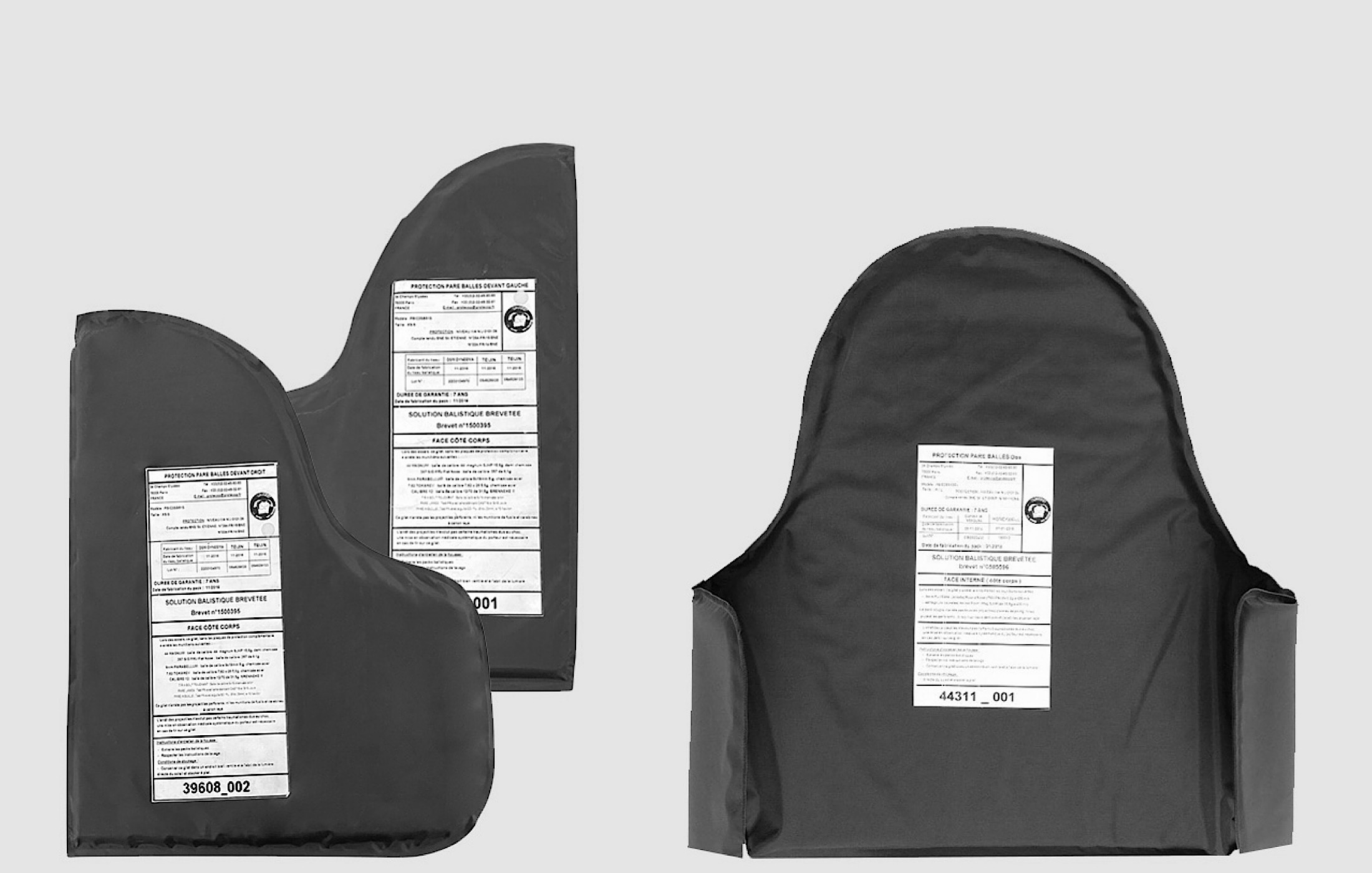
Ballistic protection materials: Kevlar & Polyethylene
The heart of a bulletproof vest or jacket lies in its composite fibers.
Two materials dominate modern technologies:
Kevlar – The legendary aramid
Invented by DuPont, Kevlar is up to five times stronger than steel of equal weight. Its long molecular chains stretch upon impact to “trap” the bullet in a dense network of fibers.
This soft and lightweight material allows for discreet wear, ideal for an elegant civilian jacket.
UHMWPE Polyethylene – Modern Ultralight
Fibers like Dyneema or Spectra offer an even lighter alternative, while maintaining exceptional ballistic resistance.
They disperse the energy of a projectile over a wide surface thanks to unidirectional crossed layers, guaranteeing both flexibility and efficiency.
At VEST PARIS, we combine these two technologies to create hybrid protection that is flexible, breathable, and meets the highest NIJ standards.

How a bulletproof vest stops a bullet
The effectiveness of a NIJ IIIA vest is based on a simple physical principle: dissipating energy rather than blocking it.
When a bullet hits the jacket, the fiber layers deform, stretch, and tighten around the projectile.
Kinetic energy is converted into heat and deformation, slowing the ball to a complete stop.
It is this dissipation of energy—not absolute rigidity—that saves lives.
The importance of comfort and fit
A bulletproof vest only provides effective protection if it fits perfectly.
Too loose, it leaves vital areas exposed; too tight, it hinders breathing and mobility.
Level IIIA, thanks to its flexibility, offers incomparable freedom of movement compared to the rigid plates of the higher levels.
The V007 jacket from VEST PARIS takes this concept further: its ergonomic architecture ensures even weight distribution, while maintaining a sober urban line — without a “tactical” effect.
NIJ Protection Levels
Ballistic protections are classified according to NIJ standard 0101.06:
| Level | Type of threat | Main use |
|---|---|---|
| I / IIA | Small calibers | Discreet, flexible |
| II | Standard handguns | Light security |
| IIIA | Large caliber handguns | Civilians & Law Enforcement |
| III | Assault rifles | Military / Gendarmerie |
| IV | Weapons of war | Military only |
Level IIIA is therefore the ideal balance point: it protects against most handguns while remaining portable for everyday use.
Elite unit vests: from IIIA to IV
Special units use level III or IV vests, incorporating rigid ceramic or reinforced polyethylene plates.
These plates fragment the projectile and absorb residual energy, but they are heavy, inconspicuous and reserved for military use.
Civilians therefore prefer flexible solutions such as VEST PARIS jackets, capable of combining mobility, discretion and ballistic performance.
Water resistance and maintenance
Kevlar and polyethylene are sensitive to moisture and UV rays.
This is why VEST PARIS protects its ballistic inserts in airtight envelopes and chooses waterproof outer fabrics.
FURTIV by VEST PARIS clothing, for example, remains effective even in the rain, while remaining breathable.
Recommended maintenance:
Store flat or hanging, away from heat.
Avoid machine washing.
Check ballistic panels every 12 months.
Replace after 7 years for maximum effectiveness.

The VEST PARIS vision: elegance and protection combined
Where others see tactical gear, we see trusted clothing.
Our ambition: to make protection invisible, without compromising on aesthetics.
The V007 jacket, NIJ IIIA certified, embodies this balance.
Lightweight, discreet, and adaptable, it offers the luxury of inner calm in the face of an increasingly uncertain world. At VEST PARIS, security becomes an art of living.
FAQ
What is the NIJ IIIA standard?
This is the classification for ballistic protection against handguns (.44 Magnum, 9mm). It guarantees maximum civilian safety while remaining flexible and lightweight.
What is the difference between NIJ IIIA and NIJ III?
Level IIIA stops pistol bullets, while Level III protects against rifle fire. The former is flexible and lightweight, the latter rigid and military-grade.
Does Kevlar also protect against knives?
No, not always. Some models, like the V007 jacket, incorporate blade protection in addition to ballistics.
Is a bulletproof vest heavy?
A NIJ IIIA vest weighs about 2 kg , the equivalent of a leather jacket. Modern technology allows for comfortable and discreet wear.
Can you travel with a bulletproof vest?
Yes. NIJ IIIA-certified civilian models are authorized in France and Europe . They do not trigger security gates and can be worn freely.